GEO vs. SEO — what actually changes.
SEO earns rankings, GEO earns citations. The complete side-by-side in one table, the five operational differences — and why you still don't have to choose between them.
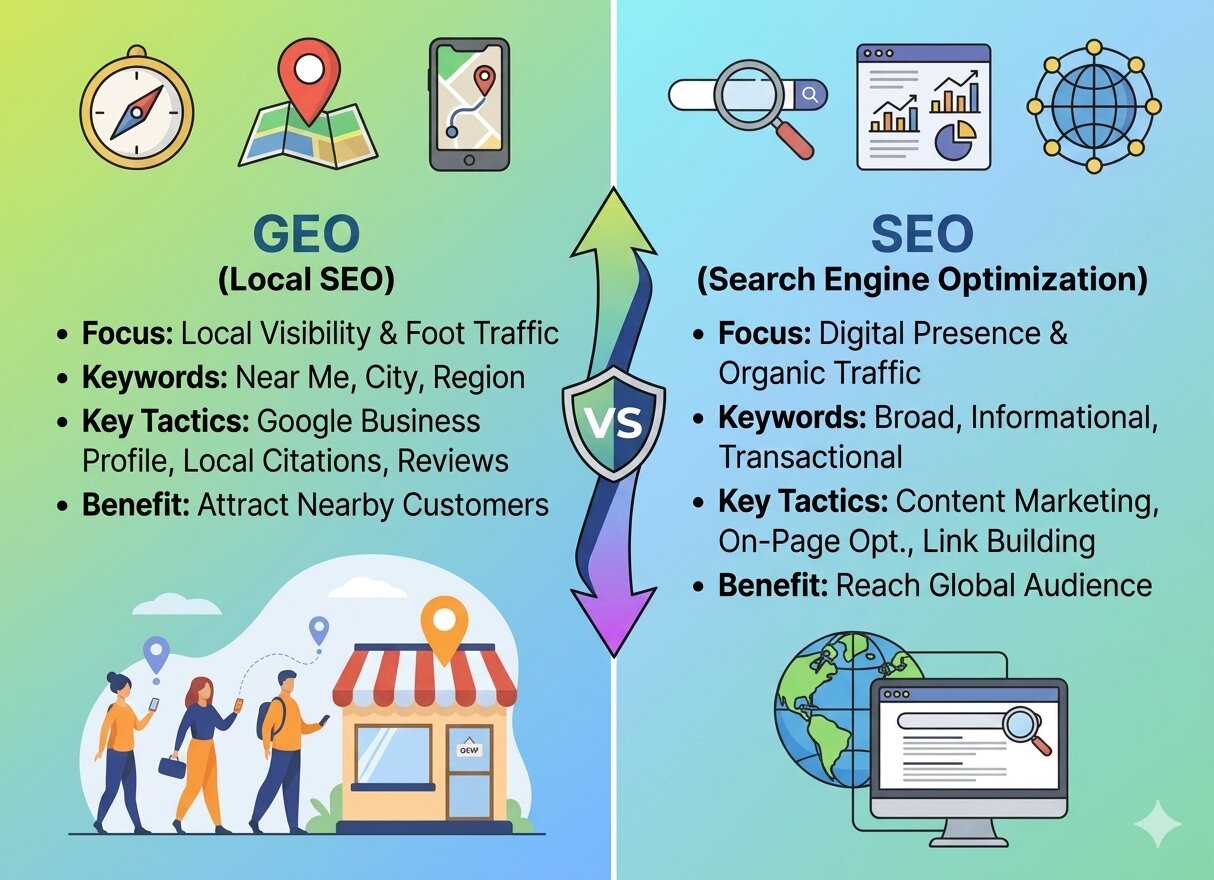
SEO (search engine optimisation) earns your website rankings: positions on a results page where users choose for themselves. GEO (generative engine optimisation) earns it citations: being selected as a source when ChatGPT, Perplexity or Google AI Overviews formulate the answer themselves. Same foundation, a different competition — and five places where the work concretely differs.
This post is the side-by-side we draw on the whiteboard in every first call. Once, completely — as a table and in plain language.
The side-by-side in one table
| Dimension | SEO | GEO |
|---|---|---|
| The goal | a position on the results page | a citation inside the formulated answer |
| The unit of competition | the page (URL vs. URL) | the passage (paragraph vs. paragraph) |
| Who decides | ranking systems + the clicking user | the language model selecting sources |
| The outcome for you | a click to your website | a mention — with or without a click |
| Visible competition | 10 blue links; you can see your position | 2–5 cited sources; absence is invisible |
| Decisive signals | relevance, links, user signals, Core Web Vitals | extractability, sourced numbers, entity clarity, third-party sources |
| Technical base | crawlability, indexing, canonical, sitemap | crawler access (robots.txt), llms.txt, Markdown versions, schema |
| Measurement | Search Console: impressions, clicks, position | citation monitoring per engine, monthly question matrix |
| Maturity of the discipline | 25 years, established standards | young, standards forming — a head start is still cheap |
What stays the same — the more important part
Anyone selling GEO as a replacement for SEO has misunderstood one of the two. The common ground carries more weight than the differences:
- Quality decides in both worlds. Helpful, factually correct, experience-rich content — Google’s E-E-A-T standard — is exactly what answer engines prefer to cite, too.
- Speed pays in twice. Fast, statically delivered HTML clears the Core Web Vitals thresholds (SEO) and is simultaneously what AI crawlers with limited reading budgets prefer (GEO).
- Google itself draws no line. For AI Overviews, Google states the same quality and ranking systems apply as for classic search — no special files, no separate “AI content”. The GEO-specific infrastructure targets the other engines: ChatGPT, Perplexity, Claude, Copilot.
- One and the same page serves both — when it’s built right. There is no “SEO text” with a “GEO text” next to it. There is well-structured content that ranks and gets cited.
The five operational differences — what you do differently from Monday
1. You write answers, not just pages
SEO logic asks: “does this page cover the search intent?” GEO logic adds: “can a model lift a paragraph from this page that answers the question standing alone?” In practice: every section opens with the 40–60-word answer, subheadings are questions, comparisons live in tables. The Princeton GEO study (KDD 2024) quantified the effects: citing sources +40% AI visibility, statistics +37%, quotations +30% — keyword stuffing −10%.
2. You open a second door in robots.txt
For SEO it was enough that Googlebot may enter. For GEO every answer engine needs its own allowance — GPTBot, OAI-SearchBot, ClaudeBot, PerplexityBot, Google-Extended. Many websites block them wholesale without knowing; the 10-second test shows it.
3. You ship a machine-readable version alongside
A sitemap and clean HTML are enough for Google. Answer engines with limited reading budgets get served additionally: an llms.txt as a curated table of contents and Markdown versions of the key pages — on our site, every main page and every blog post has an .md twin.
4. You maintain an entity, not just a domain
SEO rewards domain authority. Language models work with entities: consistent master data everywhere, Organization schema on every page, linked profiles, presence in the third-party sources engines prefer to cite from. How to diagnose where it breaks down — we documented the full protocol.
5. You measure differently — and accept fuzziness
Rankings are stably measurable; Search Console delivers the truth for free. AI answers vary between runs, models have training cutoffs, providers change source selection unannounced. Serious GEO measurement therefore means: a fixed question matrix, every month, per engine, trend over single case — visible in our live dashboard, honesty included.
And SXO? The third link in the chain
A ranking or a citation earns the visit — SXO turns it into an enquiry: load time, stability, clear conversion paths. The chain is only complete as a trio: get found (SEO), get cited (GEO), convert (SXO). Which is why “GEO & SXO” is a pillar for us, not an appendix.
The verdict — and the wrong question
“GEO or SEO?” is the wrong question. Both run on the same foundation: fast engineering, clear structure, content with substance, a clean entity. If you have the foundation, GEO comes at marginal cost. If you don’t, the finest llms.txt won’t help.
The right question is: where do you stand today — in search and in the answers? That is exactly what the free audit answers: measurements, competitor comparison across both worlds, a prioritised plan, within 24 hours. The access test you can run right now: is your website open to AI?