AI search is no longer optional — after Google's 2026 updates.
The May 2026 core update and Google I/O rewired search: AI Overviews on nearly half of all queries, AI Mode past one billion users, organic clicks more than halved on some terms. What the data says — and what to do about it Monday morning.
In May 2026, Google did two things almost at once. At I/O it announced the biggest redesign of the search box in over 25 years, made Gemini 3.5 Flash the default model in AI Mode, and previewed “information agents.” Days later, on May 21, it began rolling out the year’s second core update — completed globally by June 4, 2026. Read together, this is no coincidence: Google is rewiring search around the AI answer, not the ten blue links.
For any business that takes organic visibility seriously, this is the moment GEO (Generative Engine Optimization) stops being a “nice to have” and becomes mandatory. This post is the sober assessment: the numbers, what concretely shifted, and the plan.
The numbers behind the urgency
This is no longer a forecast — it’s the measured present:
| What | Value | Source |
|---|---|---|
| AI Overviews now appear on … | ~48% of tracked queries (Feb 2026, up from ~31% a year earlier — +58%) | BrightEdge |
| AI Overviews reach | 2.5 billion users per month | |
| AI Mode reach | 1 billion+ users in its first year (75M as recently as Dec 2025) | |
| Click loss for top organic results when an AI Overview appears | −34% to −64% | BrightEdge |
| User behaviour on an AI Overview | only ~8% click a result; ~26% end the session immediately | Pew Research |
The message is unambiguous. Google still holds 90%+ market share — search isn’t going away. But the click is. More and more often the machine answers the question itself and names two to five sources. Whoever is in those sources wins. Whoever isn’t is invisible — and won’t even notice, because there is no “position 11” to land on.
What Google actually changed in May 2026
Three things from I/O and the core update belong together:
- The search box was rethought. The first touchpoint is no longer a list, it’s a dialogue. AI Overviews sit automatically at the top of informational queries; AI Mode is the deliberate, multi-step research session.
- Gemini 3.5 Flash became the default. Better, faster synthesis means longer, more self-sufficient answers — and therefore less reason to click at all.
- “Information agents” were previewed. The direction is clear: search surfaces that complete tasks, not just return links. Visibility increasingly means appearing in the machine’s work, not its link list.
The May 21 core update wasn’t a separate story. It rewards the same properties AI answers cite: helpful, well-evidenced, experience-backed content — Google’s E-E-A-T bar. Classic SEO and GEO converge on the same foundation.
Why “but we rank well” no longer cuts it
Holding position 1 is still valuable — but it no longer guarantees a visit when an AI Overview above your result has already given the answer. The discipline shifts:
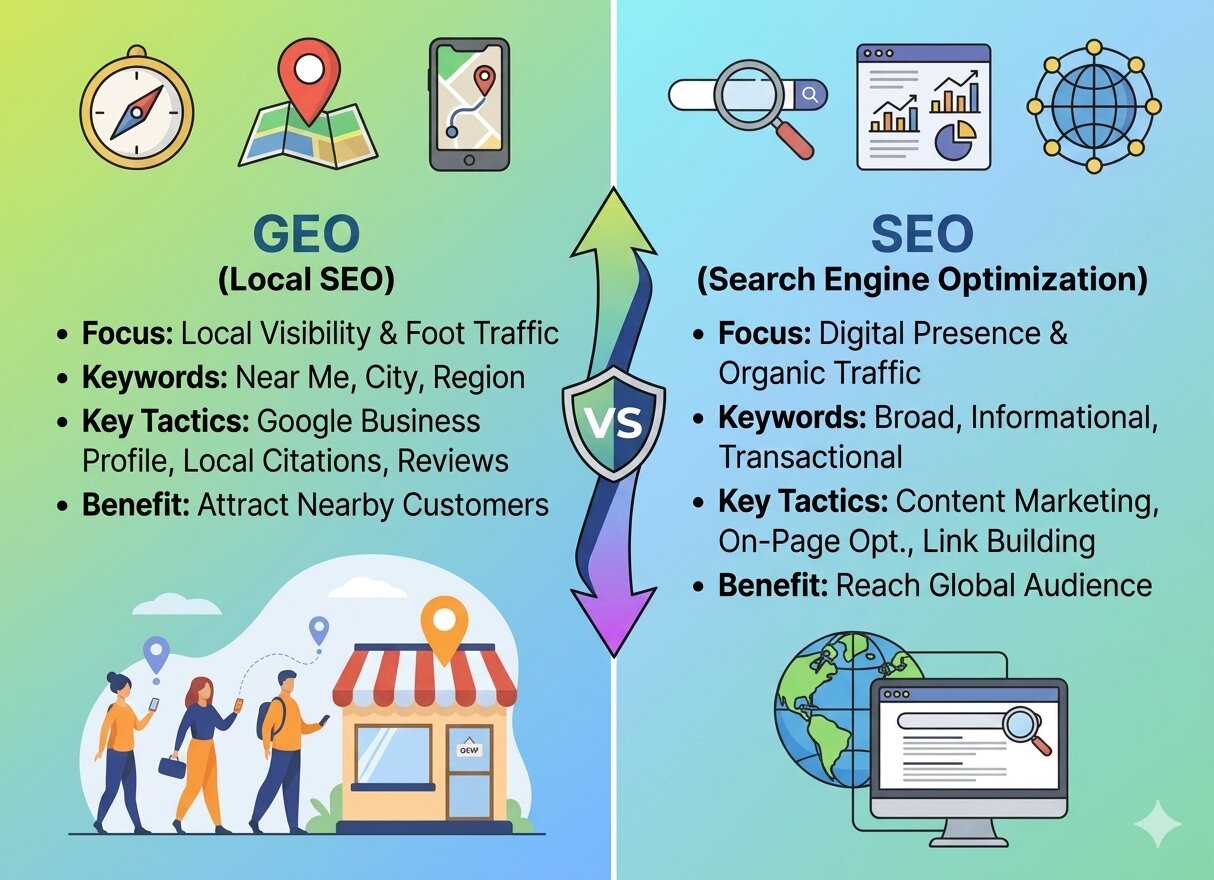
- SEO competes for the position on the results page. Unit of competition: the page.
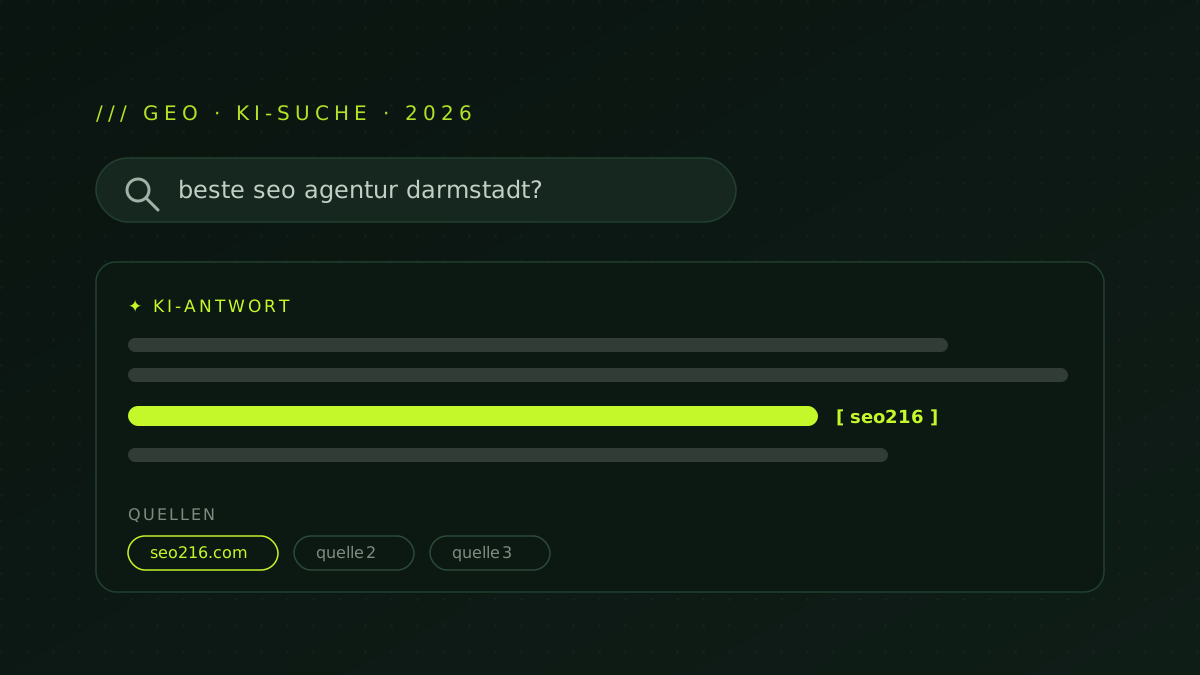
- GEO competes for the citation in the formulated answer. Unit of competition: the passage.
The good news: you don’t have to choose. We’ve written the full GEO-vs-SEO comparison here — the short version is that both stand on fast tech, clear structure and real substance. If you have the foundation, GEO comes at marginal cost.
What to do Monday morning
Four levers, in order of impact:
- Check access. AI answer engines only cite what they’re allowed to read. GPTBot, OAI-SearchBot, ClaudeBot, PerplexityBot, Google-Extended — many sites block them unknowingly. The 10-second test shows it.
- Write answers, not just pages. Each section opens with the 40–60-word answer, subheadings are questions, comparisons go in tables. The Princeton GEO study (KDD 2024) quantifies the effect: cited sources +40% AI visibility, statistics +37%, quotations +30%.
- Ship machine-readable. An llms.txt as a curated table of contents, Markdown versions of the key pages, FAQ and HowTo schema. On our own site, every primary page and post has a
.mdtwin. - Measure what gets cited. Rankings alone are no longer enough. A fixed question matrix, every month, per engine — trend over anecdote. Where you’re cited, where competitors got there first, where the next citations sit.
These four levers are exactly what we bundle into the “GEO & SXO — visibility in AI answers” pillar: citable structure, an AI-bot allowlist, schema, and a monthly citation report across five engines.
The bottom line
The question is no longer whether buying intent moves into the AI answer — the spring-2026 numbers settled that. The question is whether you show up there before your competitor does. Being in the citations early is cheaper than catching up later, once the discipline is mature and the spots are taken.
Where you stand today — in search and in the answers — is what the free audit measures: your metrics, a competitor comparison across both worlds, a prioritised plan, within 24 hours. You can run the access test yourself right now: Is your website open to AI?